




Tools, tips, and support for life with HAE
Explore resources created to help empower your life with hereditary angioedema (HAE).
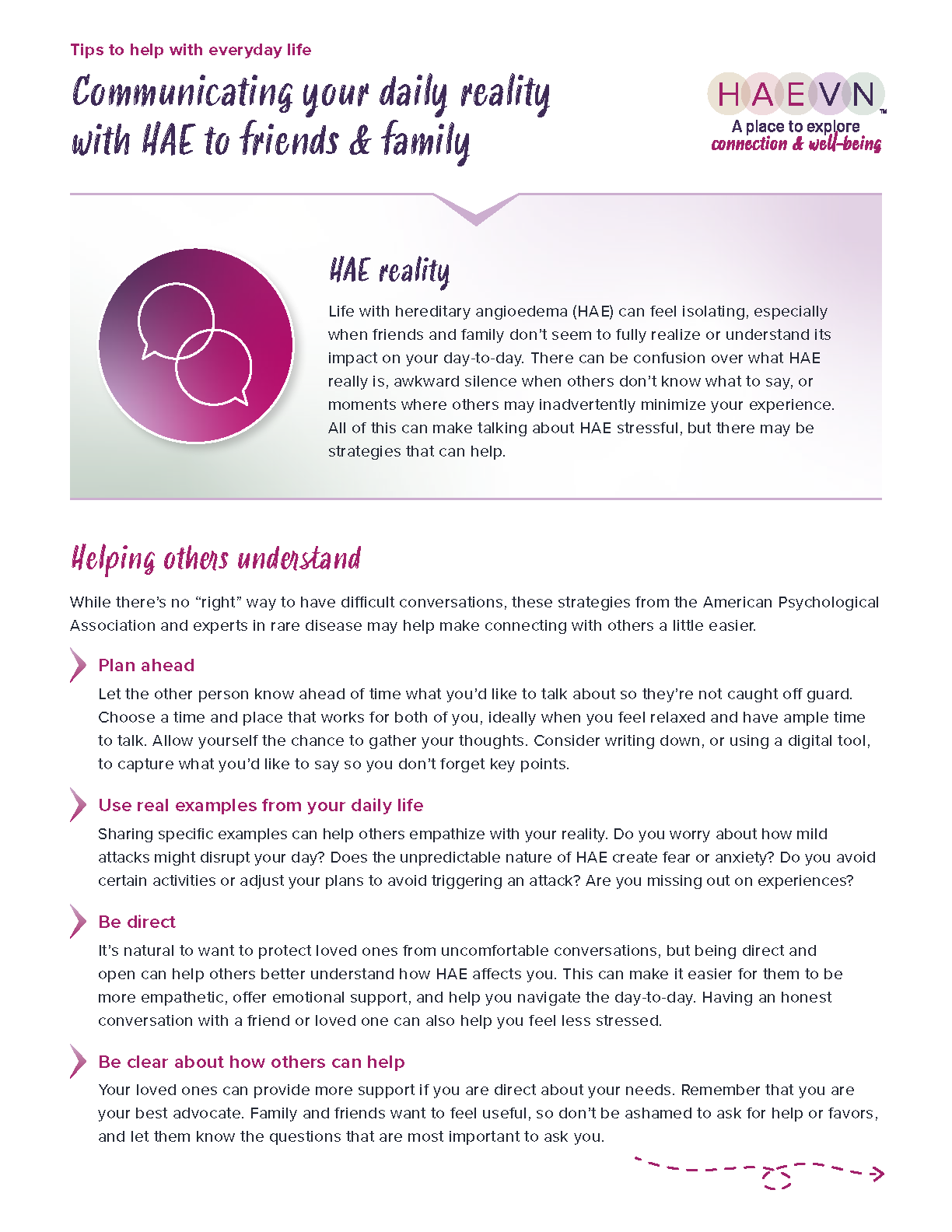
Hi, my name is Kobe. I am 22 years old and I was diagnosed with HAE when I was 14 years old.
Acceptance is a funny word. You have to accept your circumstances. There's sometimes I've had to reach out to my friend and say, I can't make your birthday dinner because I'm suffering an attack right now. And that just is what it is. I won't be in the... and for me, I think about the big life of it all. If it's 21st birthday or your 18th birthday and I've missed this big life event, and I'll never be a part of those pictures because I wasn't available this one evening.
It's easy to get caught up in feeling like, “oh, why me?” Or “how could this be different?” Or “if only I didn't have to”. Do you have to accept a lower quality of life that you didn't ask for? Absolutely not.
And that's why I think advocating on any level that is available to you is imperative. It's because access is not the same as it was 10 years ago, and it will not be the same in a decade if we continue this way, and that's for the better. So, no. Do you have to accept terrible, terrible side effects and life altering circumstances and missing big family moments? Absolutely not.
I don't want to cope with it.
We are on an upward trajectory, and we have been for a long time, and that's beautiful. But it doesn't happen by accident and it certainly doesn't happen with the absence of effort. There are so many people trying so hard to continue to improve our lives and the quality of them at any given moment.
My advice for our community to continue this progress is to stay persistent and steadfast in the understanding that we deserve a life that is regular to any person.
My name is Jennea. I'm 43 years old. I was diagnosed at the age of 27 with HAE.
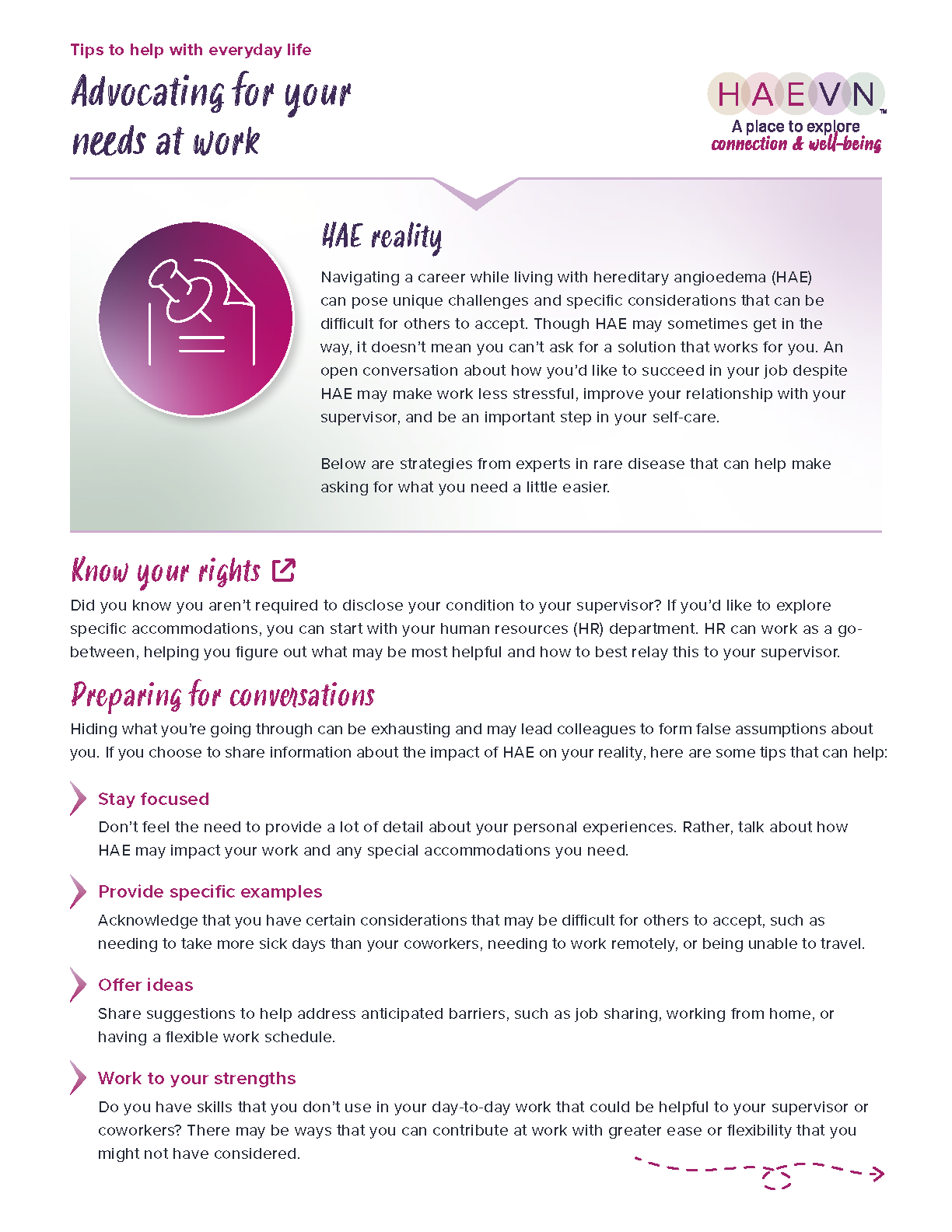
It's important for the people with HAE to be the biggest advocate because we know our own bodies. We know what we need, and if we don't advocate for ourselves, we can't expect anybody else to advocate for us.
I feel like if you don't let others around you know, you have HAE, I feel like you're hiding a very important part of your life. And also, if you were to get sick and couldn't breathe, how is anybody going to know if you're not open and honest with them what you have? And they need to know what you need them to do for you when you can't speak for yourself.
You have to be open with it. Whether it's you dating somebody, or whether it's your friends, your coworkers, definitely in the stressful situation. Your coworkers need to know that you have medication that you need to be treated with.
I definitely feel that you need to speak up about what you want to do, even though you do have HAE speaking up, bringing it to light, speaking about it to other people, can help you get the advice that you need for you to accomplish goals that you want to set for yourself. Speaking the goals out in the universe. There's somebody out there that's going to help you achieve those, and you're just going to feel that much more better about yourself.
Hi, my name is Jamie and I have HAE.
I think that anyone that's diagnosed with a chronic illness is going to have to accept that there will be some changes to their daily life. Whether or not they choose it to be a negative thing, or a positive thing depends on the person and depends on their outlook in life.
I'm from Oklahoma, so our summers are brutal. So, if there's any type of function that involves going outside, then I automatically, that's just, I'm sitting it out. It's even hard sometimes walking from a parking lot into a store in the heat. I mean, it's just that much of a trigger.
I have to have pants in five sizes because I never know what size I'm going to be when I wake up, or what size I'm going to be at the end of the day.
I'm very lucky because my friends and family don't let my HAE affect my relationships with them. And they understand if I need to cancel because I'm swollen. they understand if I need to sit something out because it’s hot and I am going to swell up like a blimp. And they understand it's just not a good day and I don't feel well. So, I'm very, very lucky.
I would tell someone with HAE who's having a bad day or feeling overwhelmed that it's okay to stop and take a deep breath, and that that's probably one of the best things you can do for yourself is to know when to just stop and take a deep breath. Because HAE can be exacerbated by stress. And while it's so easy to freak out with this disease, it's just as important to remind yourself to breathe and to be patient with yourself and to give yourself grace when it comes to feeling overwhelmed.
Hi, my name is Jamie, and I have HAE.
If I could give anyone with HAE, and newly diagnosed with HAE, any advice it would be to be patient and to do as much research as you can, because a lot of times you're going to have to be your own advocate in the beginning because it's so rare.
It's okay for people in the HAE community to want to be able to do the things that they were able to do before. I personally love to play golf. In the summertime, I just… I’ve accepted I can't do it. And so, that's part of researching and seeing what's available out there to give ourselves hope that there is something that could enable us to do the things we loved and had to give up again.
I would love to be able to lay out in the sunshine again. I would love to be able to just be outside and enjoy it and not have to worry about how long it's going to be before I start swelling up.
My hope for the future of the HAE community is that we can all find therapies that benefit us and allow us to have the best possible quality of life that we can. And I understand that that is going to look different for every single one of us because it's such a rare disease that it affects every single one of us differently.
Hi, my name is Kobe. I am 22 years old, and I was diagnosed with HAE when I was 14 years old.
Community is the lifeblood of any movement of any like-minded people; getting together and chatting is the only way anything has ever gotten done, ever. I've been fortunate enough to have been grandfathered into the HAEA and the summits and all those fun community building experiences because my mom started going when I was very, very little.
And so, to grow up and look around and see people that you know, that suffer, so to speak, but that have positive stories in real lives outside of this disease and jobs and families and stories to tell, and anecdotes to spin that have nothing to do with this experience that affects us all adversely.
And you realize that on a human level, you can come together with that empathy and then kind of forget that it's the pressing circumstance that brings you together, if that makes sense.
I'm like all my HAE friends. We don't chat about HAE. But I know these people through this, but not because of it. And I don't only know them for their disease. My HAE is not the same as my mom's or my brother's, or my cousin, or my other cousin, or my auntie or whoever. We all have very, very different experiences with it, but the very fact that we all have a piece of paper that says, this is what we experience… brings us together on that level.
There's a fundamental level of 'I see you' and 'we see each other' that comes with this kind of community.
Hi, my name is Jennea. I'm 43 and I have HAE.
I believe my biggest change I had to do with my life when it came to HAE was… I had to stop planning things with my family just because of the disappointment. Still to this day, my kids hate the fact that I cannot make any solid plans for anything because of the HAE, just because it's unpredictable when you're going to have a swell. So, it's very hard to commit to plans. So, my kids hate that about me. I never tell them we're going to do anything until the last minute.
We have always had such a difficult time having somewhat of a normal life. I think we end up accepting the little things that we have to accept just because... I couldn't tell you that I could go be able to walk out the house without meds or think about a family vacation, planning it around when I'm going to get a medication shipment.
It just became a normal thing that I've had to just deal with in my life, and it's became a normal to me.
Don't give up when you feel that you're just at a breaking point. We've all been there, but we all can get through this. If you fight for yourself and just advocate, get medication, talk to doctors, go to programs, do whatever you have to do to fight for yourself.
There's plenty of us out there, obviously, through meetings, through community dinners. Get out there. Find your people. Without your people, you feel like you're solo. You're not solo. There's plenty of people out there that are willing to help you and just give you a sense of not being alone, because we're not alone.
We have a big community, and we all have big hearts. We all want to help each other and be there to support each other.
JANET:
Hi, my name is Janet and I'm the mother of Jamie
She's the first person that I've ever known that has HAE. She was diagnosed eight years ago, and she's the first person in our family that's been diagnosed with this disease.
The thing that I wish people understood more about HAE is its unpredictability. She has no idea when she's going to experience a swell and how it's going to affect her or what she's doing, and that there's just so many unknowns about this disease right now.
I also want to say that I'm very proud of the way that she handles it because like I said, it's very unpredictable. One thing I wish Jamie understood about my role as her mom, is that whether she believes it or not, I always have her best interest at heart. Even though she might get tired of hearing me. My role as mom has kind of changed since her diagnosis because I think I'm a lot more protective of her, and I don't know if she gets tired of me nagging at her.
JAMIE:
I don't feel like my mom nags. I think she's, like she said, she's acting from having my best interests in mind and I'm, I'm very stubborn, so I don’t… she'll offer to drop me off at the door, but at the same time, I don't want her to, because I want to be able to walk like a normal person. And so I would say that is one thing that I do give up in daily life is just even something as minor as that.
JANET:
I think it's important that you let your doctor know how this disease impacts you so that they have a better understanding of the disease.
She can tell 'em, we can go in and say she's having an HAE attack or to go in to the doctor and he just knows this, this, and this from what he's read in the book. But if she explains to him, “this is what happens” and “this is how I react”, then I think that gives 'em a better education than just what they can read in a textbook.
JAMIE:
She's advocated for me when I couldn't advocate for myself.

US HEREDITARY ANGIOEDEMA ASSOCIATION
The US Hereditary Angioedema Association (HAEA) is a non-profit advocacy and research organization dedicated to supporting people living with HAE and their families. It offers resources and personalized services tailored to the unique needs of the HAE community, while working closely with physicians to improve quality of life, promote earlier diagnosis, and expand treatment options.